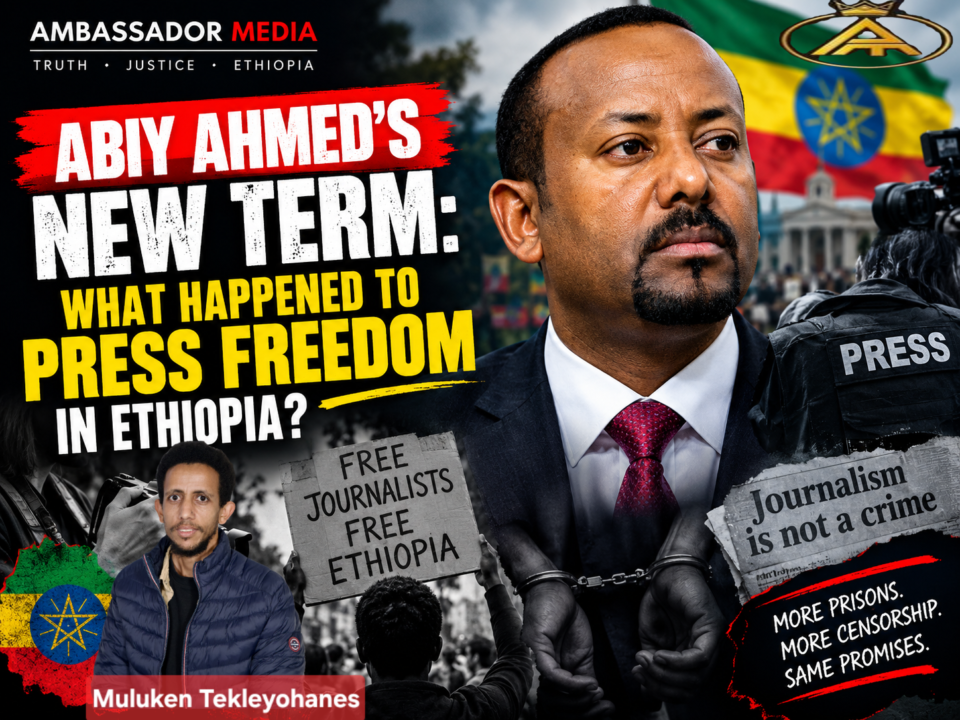
The Prime Minister Was Sworn In Again. Ethiopian Journalists Are Still Paying the Price.
Germany — October 5, 2026
Abiy Ahmed has been sworn in for another five-year term as Prime Minister of Ethiopia.
But as the government celebrates another political mandate, Ethiopia’s journalists have a different question:
What happened to the promise of press freedom?
When Abiy Ahmed came to power in 2018, journalists and media organizations welcomed what appeared to be a historic opening. Banned media outlets were allowed to return, websites were unblocked, political prisoners were released and journalists who had been forced into exile began to hope that they could return home and work freely.
Those reforms were real.
But they did not last.
Today, Ethiopia’s independent press is again operating under fear.
From Reform to Repression
Reporters Without Borders ranks Ethiopia 148th out of 180 countries in its 2026 World Press Freedom Index. RSF says many of the gains made after 2018 have been reversed and describes Ethiopia’s press environment as being severely affected by conflict, government pressure and insecurity.
This is not simply a number on an international ranking.
Behind that number are journalists.
People who investigate.
People who ask questions.
People who document violence.
People who report what powerful politicians would rather the public never see.
And people who have paid an enormous personal price for doing their jobs.
Journalism Has Become a Security Question
One of the most dangerous developments under Abiy’s government has been the increasing use of national-security arguments against journalists.
RSF reports that journalists covering the Tigray and Amhara conflicts who did not follow the government’s preferred narrative have faced detention and serious accusations, including terrorism-related charges. RSF also reports that some journalists remain imprisoned because of their reporting on the conflicts.
When journalism is treated as a security threat, democracy itself becomes the casualty.
A journalist asking where civilians were killed is not an enemy of the state.
A reporter documenting displacement is not a terrorist.
A media outlet investigating government conduct is not a national-security threat.
The public has a right to know what is happening in its own country.
The Independent Media Is Being Warned
The pressure has not disappeared in 2026.
In August, the Committee to Protect Journalists reported that Ethiopian authorities detained the editor-in-chief of Addis Standard, raided the newsroom and seized or destroyed equipment. CPJ described the incidents as part of a campaign against the outlet.
That should alarm every journalist in Ethiopia.
Because when one newsroom is attacked, the message reaches every other newsroom:
Be careful what you publish.
Be careful whom you criticize.
Be careful what you investigate.
And eventually:
Be careful what you say.
That is how self-censorship grows.
Five Journalists and a Country Still Waiting for Answers
RSF’s current Ethiopia profile lists five journalists detained in 2026.
CPJ has also documented individual cases of journalists being detained over their commentary. In June 2026, journalist Salsawit Baynesagn was detained after publishing social-media commentary criticizing the government and others over violence against Orthodox Christians. She was ultimately released without charge.
These cases should not be dismissed as isolated incidents.
They contribute to an environment in which journalists must constantly calculate the consequences of telling the truth.
And when journalists begin calculating whether the truth is worth the risk, society loses access to the truth itself.
Abiy’s Biggest Broken Promise
Abiy Ahmed once presented himself as a leader who would open Ethiopia’s political and media space.
That promise created enormous hope.
But the question for his new term is no longer whether he can make another promise.
The question is whether he will reverse the shrinking space for independent journalism.
Because press freedom cannot exist when journalists are afraid of arrest.
It cannot exist when newsrooms can be raided.
It cannot exist when equipment can be confiscated.
It cannot exist when terrorism laws can become tools against critical reporting.
And it cannot exist when journalists are forced to choose between silence and exile.
A Government Should Fear Lies—Not Journalism
The Ethiopian government does not have to agree with journalists.
It does not have to like criticism.
It does not have to accept every investigation.
But it has an obligation to protect the fundamental right of journalists to work without intimidation.
A strong government should be able to tolerate criticism.
A confident government should be able to answer difficult questions.
A democratic government should understand that journalists are not its enemies.
The enemy is the absence of accountability.
To Abiy Ahmed: Your New Term Must Not Become Another Dark Chapter for Journalism
Prime Minister Abiy Ahmed has received another five-year mandate.
But that mandate should not be interpreted as permission to silence critics.
It should not be interpreted as permission to intimidate journalists.
It should not be interpreted as permission to control the national narrative.
And it certainly should not be interpreted as permission to turn journalism into a crime.
If Abiy genuinely wants his new term to be remembered as a period of democratic renewal, he should begin with one simple commitment:
Let Ethiopian journalists work freely.
Release journalists who are being detained for their journalism.
End intimidation of independent newsrooms.
Stop using vague security provisions to criminalize legitimate reporting.
Protect journalists covering conflicts.
Allow independent media to investigate government conduct.
And guarantee that criticism of the government will not automatically be treated as hostility toward the state.
Because Ethiopia Needs Journalists
Ethiopia does not need fewer journalists.
It needs more.
More reporters in Addis Ababa.
More reporters in Tigray.
More reporters in Amhara.
More reporters in Oromia.
More reporters documenting what happens to civilians.
More investigative journalists asking where public money goes.
More journalists challenging politicians.
More independent media giving citizens information that state-controlled narratives cannot provide.
And above all, Ethiopia needs journalists who are free to tell the truth without having to choose between prison, silence and exile.
Abiy Ahmed has begun another five-year term.
For journalists, however, the question is not whether the Prime Minister can stay in power for another five years.
The question is whether independent journalism will survive those five years.
And that is a question the government cannot answer with speeches.
It must answer with actions.
Press freedom is not a privilege granted by a government.
It is a right that a democratic government must protect.
Ambassador Media
