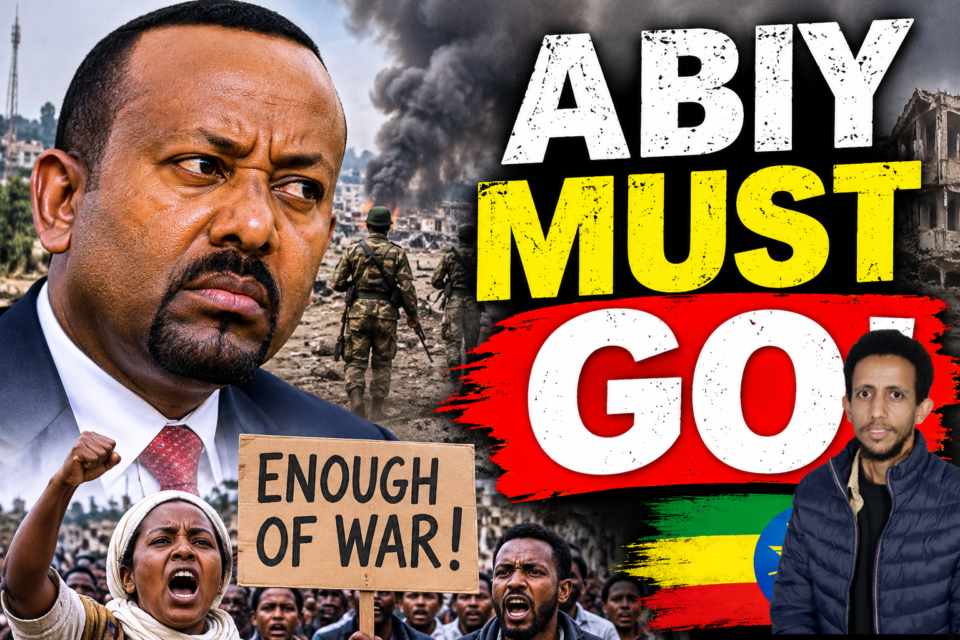
Renewed conflict, civilian deaths, political repression and the failure of national leadership threaten to push Ethiopia into another devastating catastrophe.
By Muluken Tekleyohanes
Editor-in-Chief & General Manager, Ambassador Media
November 11, 2026
AMBASSADOR MEDIA | SPECIAL INVESTIGATIVE EDITORIAL
A Nation Abandoned by Its Leadership
Ethiopia is once again standing on the edge of a devastating national catastrophe. Across the country’s northern regions, particularly Tigray, Amhara and Afar, renewed fighting has shattered an already fragile peace. In Oromia, persistent armed conflict and attacks against civilians continue to deepen insecurity. Millions of Ethiopians face uncertainty, displacement, economic hardship and the terrifying possibility of another prolonged civil war.
The country that was promised peace, political reform and national reconciliation has instead become trapped in a recurring cycle of armed confrontation, political instability and human suffering.
At the centre of this unfolding crisis stands Prime Minister Abiy Ahmed and his government.
The administration that once presented itself as the architect of a new Ethiopia must now answer for the devastating failure of its political and security policies. Peace agreements have failed to produce lasting stability. Military operations have not resolved the country’s deep political divisions. And the promise of national reconciliation has increasingly been overshadowed by violence, mistrust and accusations of human rights violations.
Ethiopia does not suffer from a shortage of political speeches or declarations of national unity. It suffers from a profound crisis of leadership, accountability and political responsibility.
The Ethiopian people cannot continue paying the price for the failures of those entrusted with governing them.
The Return of War: A Betrayal of the Pretoria Peace Agreement
The renewed fighting that erupted in northern Ethiopia on September 21, 2026, represents a dangerous reversal of the fragile progress achieved through the November 2022 Pretoria Agreement.
The agreement was intended to end the devastating war between the federal government and Tigrayan forces. It offered an opportunity to restore essential services, facilitate humanitarian assistance, rebuild destroyed communities and establish a political process capable of addressing the underlying causes of the conflict.
Yet that opportunity has been squandered.
Renewed confrontations between federal forces and Tigrayan fighters have spread across parts of Tigray, Afar and Amhara. The federal government and Tigrayan political and military actors continue to exchange accusations over responsibility for the escalation.
The fighting has also created new fears of regional destabilisation, particularly amid tensions involving Eritrea.
The Pretoria Agreement was never supposed to be a temporary pause before another war. It was supposed to establish a foundation for sustainable peace.
Both the federal government and Tigrayan authorities have obligations under the agreement. Neither can claim that military confrontation is an acceptable substitute for political dialogue.
Abiy Ahmed’s government must explain why the peace process failed to produce a sustainable settlement and what concrete steps it is prepared to take to prevent another humanitarian disaster.
A peace agreement cannot survive when political leaders treat it as a tactical arrangement rather than a genuine commitment to reconciliation.
Civilian Lives Are Becoming Collateral Damage
The most horrifying consequence of Ethiopia’s continuing conflicts is the growing vulnerability of ordinary civilians.
On October 30, 2026, drone strikes hit the Jari 2 displacement camp in the Amhara region. According to Reuters, at least 15 people, including five children, were killed, while dozens more were injured.
The camp housed people who had already been displaced by earlier violence.
Consider the cruelty of this reality: families who had escaped insecurity in search of protection found themselves exposed to another deadly attack in a place where they should have been safe.
The attackers and their motives had not been independently established at the time of reporting. That uncertainty makes an independent investigation even more urgent.
The World Health Organization has also warned about attacks affecting civilians in northern Ethiopia, including children and a newborn. Its Director-General, Tedros Adhanom Ghebreyesus, warned that the violence was pushing an already fragile health system closer to collapse.
Hospitals are struggling with shortages of medical workers, medicines and equipment. Ambulance services are severely limited, while insecurity obstructs the delivery of life-saving supplies.
This is not an abstract political disagreement. It is a humanitarian emergency.
No military objective can justify deliberately targeting civilians, hospitals, schools or humanitarian facilities. International humanitarian law demands the protection of civilian populations, regardless of which political or military authority controls the territory.
The Ethiopian government must ensure that its military operations comply with international law and that credible investigations are conducted whenever civilian casualties occur.
The families of the victims deserve answers, not silence.
Amhara: A Region Trapped Between Armed Conflict and State Failure
The continuing conflict in Amhara exposes another devastating dimension of Ethiopia’s national crisis.
Since 2023, federal forces have fought armed Fano groups across several parts of the region. The conflict has disrupted daily life, displaced communities, damaged livelihoods and created an environment in which civilians face persistent insecurity.
The government’s reliance on military operations has failed to deliver a sustainable political solution.
The people of Amhara should not have to choose between armed opposition groups and government violence. They deserve civilian protection, justice, political representation and the right to participate peacefully in determining their future.
The October 30 drone strikes at Jari 2 demonstrate why civilian protection must become an immediate national priority.
The federal authorities must explain what safeguards are in place to prevent attacks on displacement camps and other civilian locations. They must also permit independent investigations into alleged violations by security forces.
At the same time, Fano groups and all other armed actors must be held responsible for violations committed by their members.
There can be no selective justice in Ethiopia.
Oromia: The Suffering That Cannot Be Ignored
While international attention frequently focuses on northern Ethiopia, the continuing crisis in Oromia demands equally serious attention.
The armed conflict involving government forces and the Oromo Liberation Army has persisted for years, leaving communities exposed to insecurity, displacement and allegations of serious abuses.
The Ethiopian Orthodox Tewahedo Church has also reported deadly attacks against Orthodox Christians in the Arsi Zone.
According to Associated Press reporting in late October, the Church said two attacks killed at least 60 Orthodox Christians. The regional government blamed the Oromo Liberation Army, but the allegations and responsibility for the attacks require independent investigation.
The killing of civilians because of their religion, ethnicity or perceived political identity must never be tolerated.
The federal government has an obligation to protect all communities, investigate targeted killings and bring perpetrators to justice.
It cannot claim to defend national unity while communities continue to fear for their lives.
Nor should the suffering of one community be used to justify hatred or collective punishment against another.
Ethiopia’s diversity should be a source of strength, not a justification for violence.
Abiy Ahmed’s Government Must Answer for Its Political Failures
Prime Minister Abiy Ahmed came to power in 2018 with promises of democratic reform, national reconciliation and a new political direction.
Those promises created enormous expectations among Ethiopians and attracted international attention.
But the country’s subsequent trajectory raises fundamental questions about the administration’s commitment to those original promises.
The 2020–2022 Tigray war devastated communities and generated extensive allegations of serious violations of international humanitarian and human rights law. The Pretoria Agreement created an opportunity for accountability and institutional reform. Yet credible justice for victims remains inadequate.
The subsequent conflict in Amhara, persistent insecurity in Oromia and renewed fighting in northern Ethiopia demonstrate that the underlying political problems remain unresolved.
A government cannot claim success simply because it maintains control over the capital or announces military advances.
The true measure of leadership is whether citizens can live safely, express their opinions freely, access justice and trust public institutions.
Abiy Ahmed’s government must confront several fundamental questions:
- Why has the federal government failed to establish sustainable peace after the Pretoria Agreement?
- Why have military operations repeatedly replaced meaningful political negotiations?
- What independent mechanisms exist to investigate alleged abuses committed by government security forces?
- Why do communities continue to face displacement, insecurity and attacks on civilian infrastructure?
- What has happened to the promised transitional justice process?
- What protections are available for journalists, human rights defenders and civil society organisations documenting abuses?
- What concrete measures will the government take to prevent another nationwide humanitarian catastrophe?
These are legitimate questions in a democratic society.
Criticism of government policy is not an attack on Ethiopia. Demanding accountability is not an act of disloyalty. Journalism that exposes suffering is not an enemy of national unity.
A government that cannot tolerate questions about its conduct has a serious problem with democratic accountability.
The Weaponisation of National Security
One of the most dangerous developments in Ethiopia’s political environment is the tendency to frame criticism, political disagreement and demands for accountability through the language of national security.
National security is a legitimate responsibility of every government. But it must never become a blanket justification for suppressing dissent, restricting independent reporting or avoiding scrutiny of state institutions.
Journalists must be able to investigate military operations. Human rights defenders must be able to document abuses. Civil society organisations must be able to support victims without fear of intimidation.
When information is restricted, misinformation flourishes. When journalists cannot access conflict-affected communities, abuses become harder to document. When witnesses fear speaking publicly, accountability becomes increasingly difficult.
The Ethiopian government must respect freedom of expression and protect the independence of the media.
The people have a right to know what is happening in their country.
The International Community Must Stop Normalising Ethiopia’s Crisis
The international response to Ethiopia’s escalating conflicts has not matched the seriousness of the situation.
The African Union, headquartered in Addis Ababa, carries a particular responsibility. It cannot remain politically comfortable while its host country faces renewed armed conflict and allegations of serious violations.
The United Nations has already expressed grave concern about renewed fighting in Tigray, Afar and Amhara. On October 10, 2026, the UN Secretary-General called on all parties to cease hostilities and return to dialogue under the Pretoria Agreement.
Amnesty International has also called on the African Union Peace and Security Council to convene an emergency session on Ethiopia.
These statements must lead to meaningful action.
International organisations and influential governments should:
1. Demand an immediate cessation of hostilities. All parties must stop military operations that endanger civilians and return to serious political negotiations.
2. Establish independent investigations. Allegations of war crimes, unlawful killings, drone strikes against civilian locations, forced conscription and other serious violations must be investigated impartially.
3. Protect humanitarian access. Humanitarian organisations must have safe and unrestricted access to conflict-affected populations.
4. Restore independent monitoring. International human rights investigators and independent journalists must be able to access affected areas and document abuses.
5. Protect freedom of expression. The Ethiopian government must end intimidation and restrictions directed at journalists, human rights defenders and peaceful critics.
6. Support genuine political dialogue. International partners should encourage an inclusive process involving federal authorities, regional representatives, political opposition, civil society and affected communities.
7. End impunity. Accountability must apply to perpetrators regardless of their political affiliation, military position or government connections.
The international community must not wait for another mass-casualty catastrophe before taking meaningful action.
Ethiopia deserves more than diplomatic statements issued after every new tragedy.
Ethiopia Needs a Political Solution, Not Another Military Victory
Ethiopia’s crisis cannot be resolved through military force alone.
The country’s political divisions are deeply rooted in unresolved questions of governance, representation, historical grievances, regional autonomy, justice and the distribution of political power.
Ignoring these problems will only create the conditions for further violence.
A sustainable solution requires an inclusive national political dialogue supported by credible institutions and meaningful public participation.
Such a process must not be controlled exclusively by the ruling party or designed merely to consolidate the government’s political position.
It must create space for legitimate political opposition, regional voices, civil society, religious institutions, independent media and communities directly affected by armed conflict.
The government must also commit to credible transitional justice, institutional reform and the protection of fundamental rights.
Ethiopia needs a political system in which citizens do not have to take up arms to demand recognition, representation or protection.
A Message to the Ethiopian People
The suffering of Ethiopia cannot be reduced to competing political narratives.
A mother searching for her missing child does not care which political party claims victory. A displaced family sleeping in a temporary shelter does not benefit from government propaganda or rebel declarations. A patient unable to reach a functioning hospital does not receive treatment from political speeches.
The people of Ethiopia want to live.
They want their children to attend school, farmers to cultivate their land, businesses to operate without fear and communities to coexist peacefully.
They want a government that protects their rights rather than treating their demands as political threats.
They want justice for victims and accountability for perpetrators.
Above all, they want a country in which political disagreements do not repeatedly end in bloodshed.
Ethiopia belongs to its people, not to any political party, armed movement or individual leader.
The Final Question: Who Will Take Responsibility?
Prime Minister Abiy Ahmed and his administration must recognise that political power comes with an obligation to protect human lives.
The federal government cannot escape scrutiny by blaming every crisis on armed opposition groups, external interference or historical divisions.
Equally, armed opposition movements cannot escape responsibility for abuses committed by their members.
Every actor must be accountable.
But the government’s responsibility is particularly significant because it controls national institutions, commands the federal security apparatus and has the constitutional obligation to protect citizens throughout the country.
Ethiopia cannot continue sacrificing generations to conflicts that political leaders have failed to resolve.
The country does not need another declaration of military victory. It needs a credible peace process, independent justice, democratic accountability and institutions that protect every citizen.
Abiy Ahmed’s government must answer for its political failures. The international community must stop looking away. And the Ethiopian people must never be expected to accept endless war as the price of being governed.
Peace is not a favour from those in power. It is a right of the Ethiopian people.
The bloodshed must end. The silence must end. The era of impunity must end.
By Muluken Tekleyohanes
Editor-in-Chief & General Manager
Ambassador Media
EDITORIAL DISCLAIMER
This is an advocacy-oriented editorial based on publicly available reporting and human rights documentation as of November 11, 2026. Allegations against individuals and parties to the conflict should be subject to independent investigation and due process. Ambassador Media calls for accountability for all perpetrators of violations of international humanitarian and human rights law, without political or ethnic discrimination.
