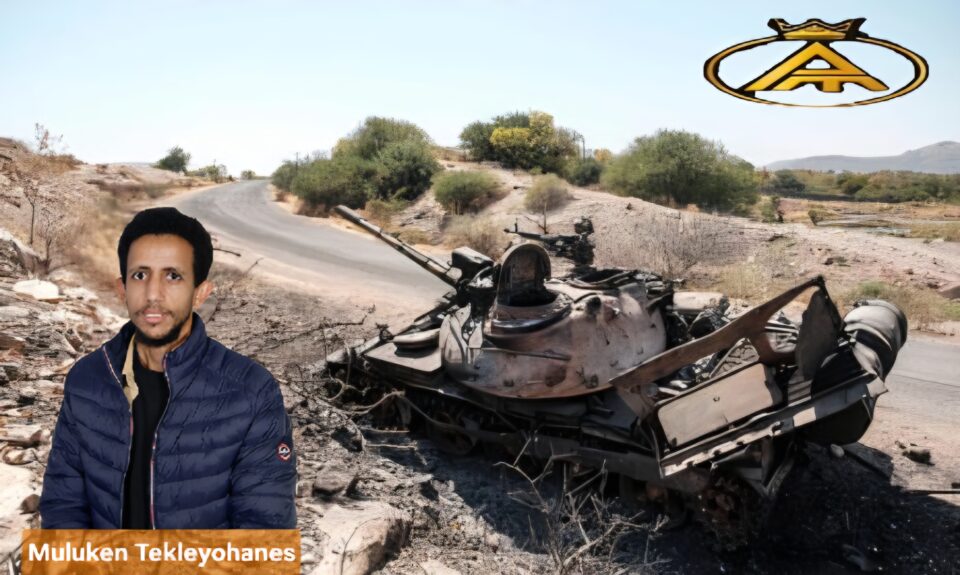
As fighting returns to Tigray and violence continues across Amhara and Oromia, the government of Prime Minister Abiy Ahmed is facing a crisis of its own making. For millions of Ethiopians, the promise of peace has once again been replaced by fear, displacement and war.
Ambassador Media- Germany – October 1, 2026
Ethiopia is once again moving toward a dangerous and familiar reality: war.
Less than four years after the Pretoria peace agreement brought an end to the devastating Tigray war, fighting has erupted again across northern Ethiopia. Federal forces and Tigrayan forces are engaged in renewed hostilities, while armed conflicts continue in Amhara and Oromia.
On October 1, explosions were reported in Addis Ababa as the conflict appeared to move closer to the country’s political centre. Reuters reported that a source linked to an opposition alliance claimed responsibility for drone attacks in the capital, although the claim could not independently be verified.
For a government that came to power promising peace, reform and national reconciliation, this is an extraordinary failure.
Abiy Ahmed promised peace. Ethiopia got another war.
When Abiy Ahmed became prime minister in 2018, millions of Ethiopians hoped that his government would end decades of political repression and conflict.
He released political prisoners. He promised democratic reform. He spoke repeatedly about reconciliation.
His international reputation grew rapidly, culminating in the Nobel Peace Prize.
But Ethiopia’s reality today is dramatically different.
The country remains fractured by armed conflict. Human Rights Watch reports continuing hostilities between federal forces and armed groups in Amhara and Oromia, while instability and renewed fighting have again engulfed Tigray.
The central question is no longer whether Abiy Ahmed inherited problems.
It is whether his government has made them worse.
A peace agreement that failed to deliver lasting peace
The Pretoria agreement ended the 2020–2022 Tigray war, a conflict associated with an enormous humanitarian toll.
Yet the political questions that contributed to that war were never fully resolved.
Territorial disputes remain. Relations between the federal government and Tigrayan authorities remain deeply strained. Political mistrust remains widespread. And now armed confrontation has returned.
Reuters reports that fighting has spread across parts of Tigray, Amhara and Afar, with federal forces claiming territorial gains while opposition forces continue their operations.
This is not simply the failure of one peace agreement.
It is the failure to build a political system capable of resolving Ethiopia’s conflicts without repeatedly turning to the gun.
The government’s answer to political opposition: security
The most disturbing pattern is not simply the continuation of war.
It is the shrinking space for peaceful disagreement.
Independent journalists have increasingly found themselves treated as security threats rather than as essential participants in a democratic society.
Human Rights Watch reported in August 2026 that Ethiopian authorities detained the editor-in-chief of Addis Standard, raided the publication’s offices and confiscated equipment. The organization described the incident as part of a broader campaign against independent media.
The Committee to Protect Journalists has likewise documented intimidation, censorship, detention and restrictions on journalists ahead of Ethiopia’s 2026 elections.
This creates a dangerous equation:
Criticism becomes a security issue.
Independent journalism becomes a threat.
Political opposition becomes an enemy.
And war becomes easier to justify.
A government confident in its legitimacy should not fear journalists asking difficult questions.
The silencing of journalists is not a side issue
For journalists who have experienced Ethiopia’s crackdown firsthand, these developments are not abstract statistics.
They are warnings.
Human Rights Watch says Ethiopian authorities have increasingly targeted independent media through arrests, raids, license restrictions and other forms of pressure.
CPJ has also documented cases involving journalists who were detained for years and allegedly pressured to make statements admitting involvement in terrorism in exchange for release.
This environment inevitably encourages self-censorship.
When journalists know that reporting about military operations, human rights abuses or government failures can result in detention, harassment or the loss of their professional licence, the public loses one of its most important safeguards.
A country cannot call itself democratic while independent journalists are forced to choose between silence and exile.
And civilians continue to pay the price
Behind every military announcement is a civilian reality.
Families flee.
Businesses close.
Schools stop operating.
Hospitals struggle to function.
Communications are disrupted.
People stockpile food because they do not know whether roads will remain open tomorrow.
Recent reporting from northern Ethiopia has described displacement, disrupted communications and growing shortages as fighting intensifies. Humanitarian and medical organizations have reported large numbers of wounded people requiring treatment.
The Ethiopian Human Rights Commission has warned that military movements and renewed fighting in areas bordering Tigray, Amhara and Afar pose serious risks to civilians’ rights to life, liberty and property.
This is what political failure looks like on the ground.
It is not measured in speeches.
It is measured in the number of families who leave their homes.
Abiy cannot blame every crisis on his enemies
The Ethiopian government has accused external actors and opposition groups of destabilizing the country. Some of those accusations may require serious investigation.
But blaming every crisis on enemies outside the government cannot substitute for political accountability inside the government.
Prime Minister Abiy Ahmed controls the federal government’s political and security institutions. His administration therefore bears substantial responsibility for creating conditions in which peaceful political competition, independent journalism and civilian protection can function.
The existence of armed opposition groups does not absolve the government of its obligations.
Nor does government failure justify abuses committed by opposition forces.
All parties to the conflict must protect civilians and respect international humanitarian law.
But the government has a particular responsibility because it claims to represent the Ethiopian state.
Ethiopia cannot be governed permanently through force
The central lesson of the last decade should be obvious:
Military solutions do not resolve Ethiopia’s political problems.
The 2020–2022 war did not eliminate political disagreements.
The 2022 peace agreement did not eliminate political mistrust.
Military operations in Amhara have not ended the conflict there.
Security operations in Oromia have not produced lasting peace.
And renewed fighting in Tigray is demonstrating once again that unresolved political disputes eventually return to the battlefield.
Ethiopia needs a political settlement, not another cycle of military victory followed by another war.
That requires genuine negotiations, independent institutions, accountability for abuses, protection of journalists and meaningful political participation.
The government must answer the questions Ethiopians are asking
Where is the lasting peace that was promised?
Why has Ethiopia returned to large-scale fighting only a few years after the Pretoria agreement?
Why are journalists and independent media increasingly treated as threats?
Why are civilians repeatedly forced to pay for political disputes between elites?
Why has accountability for serious abuses remained so weak?
And how many more Ethiopians must be displaced before political leaders recognize that another military victory cannot heal a broken political system?
These are not questions of political loyalty.
They are questions of public accountability.
A country cannot be saved by silencing those who report its suffering
For journalists in exile, the responsibility to report does not disappear when they cross a border.
In many cases, it becomes more important.
When journalists inside Ethiopia are threatened, detained or pressured into silence, journalists outside the country must continue documenting what can be independently verified and asking questions that authorities would rather avoid.
That responsibility belongs to every journalist committed to the public interest.
The Ethiopian government may attempt to control the narrative.
It cannot control the consequences of war.
It cannot erase displacement.
It cannot silence every witness.
And it cannot indefinitely hide political failure behind the language of national security.
Ethiopia deserves better than another generation of war
Prime Minister Abiy Ahmed still has a choice.
He can continue down the path of military confrontation, political repression and shrinking media freedom.
Or he can recognize that Ethiopia’s crisis cannot be solved through force alone.
The government must return to genuine political dialogue, protect civilians, restore space for independent journalism and establish credible accountability mechanisms for abuses committed by all sides.
Ethiopia does not need another war presented as the solution to the previous war.
It needs leaders courageous enough to acknowledge failure.
It needs institutions stronger than individuals.
It needs journalism that can investigate without fear.
And, above all, it needs a political system in which disagreement does not automatically become a reason to fight.
Abiy Ahmed came to power promising to transform Ethiopia. Eight years later, Ethiopia is again confronting the specter of war. The ultimate test of his leadership will not be how many territories his forces capture. It will be whether he can prevent another generation of Ethiopians from becoming victims of political failure.
Ambassador Media will continue to monitor the conflict, document developments affecting civilians and press freedom, and distinguish independently verified information from claims made by the parties to the conflict.
